
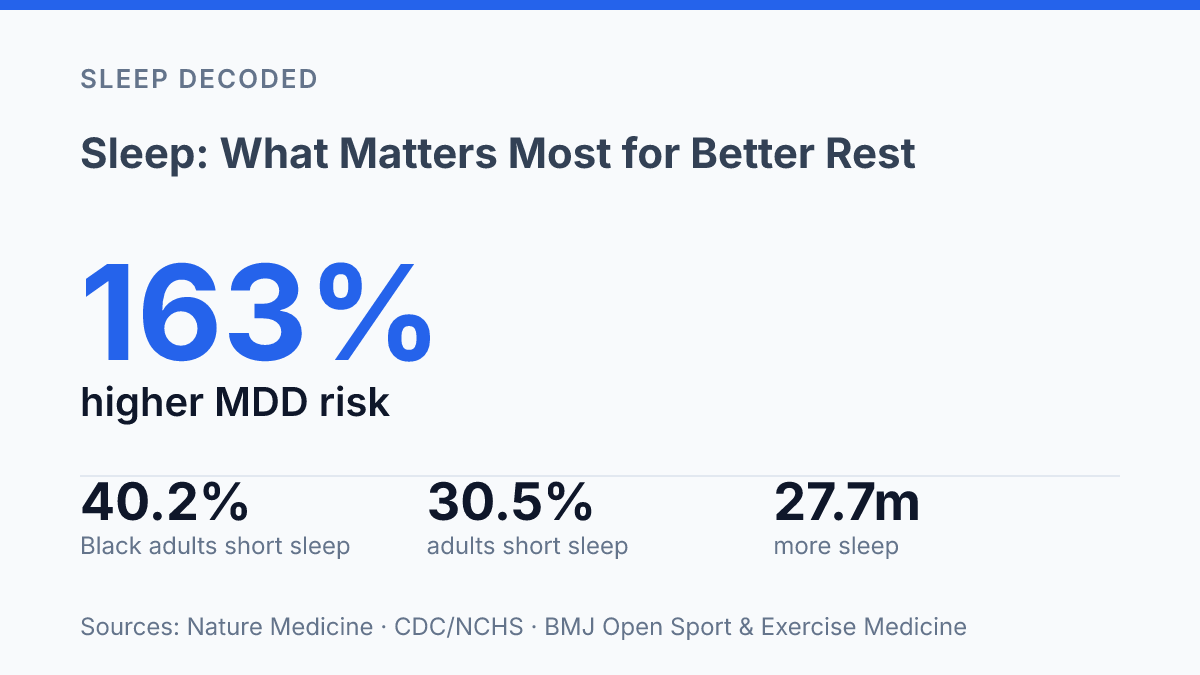
Sleep isn’t a soft wellness goal. In 2024, CDC/NCHS data showed 30.5% of U.S. adults got less than 7 hours in a 24-hour period.
That gap wasn’t evenly shared. Adults ages 50-64 were hit hardest, and Black non-Hispanic adults reported short duration far more often than White, Hispanic, or Asian adults.
Hours still don’t tell the whole story. Only a little over half of adults woke feeling well-rested most days, but 12.9% used a nightly aid most days or every day in the prior month.
That contrast matters. You can spend enough time in bed and still wake up foggy, wired, or strangely unrestored. In my honest opinion, the real problem is that too many people treat exhaustion as normal.
The sections ahead cut through the noise: how much rest your body needs, what bad nights do to your health, why consistency changes the equation, and which small habits actually move the needle.
How much sleep you really need
Seven hours isn’t a wellness ideal. It’s the floor major medical groups use to mark adult risk.
The National Sleep Foundation set age-based recommendations in 2015 that still give readers a clear yardstick. Most adults need 7–9 hours a night, while teenagers need 8–10 hours. That gap matters if a teen is trying to run on an adult schedule.
That same year, the American Academy of Sleep Medicine and Sleep Research Society drew an even firmer line. Their statement said adults should sleep at least 7 hours each night for best health.
Not “try for it when life calms down.” At least 7.
That benchmark matters because 30.5% of U.S. adults got less than 7 hours in a 24-hour period in 2024. The rate hit 34.5% among adults ages 50–64, according to CDC/NCHS. In my view, the surprise is that most people aren’t short on motivation. They’re short on sleep time.
Needs fall sharply across childhood. They don’t shrink to nothing in adulthood.
Standard public-health guidance puts infants 4–12 months at 12–16 hours per 24 hours, including naps. School-age children 6–12 years need 9–12 hours, which explains why late activities and early buses can quietly wreck a week.
Older adults need less than children, not less than biology. Adults 65 and older generally need 7–8 hours, so waking earlier doesn’t automatically mean the body needs only 5 or 6.
The tradeoff is simple: some people feel functional near the low end. The recommended ranges aren’t elastic enough to justify chronic short nights.
What poor sleep does to your body and mind
Your reaction time can slow before you feel tired enough to call yourself impaired. The CDC warns that insufficient rest can darken mood, weaken attention, and slow reaction time.
That shows up as snapping at someone, rereading the same email, or missing a change in traffic. In my honest opinion, People treat sleep loss like a harmless bad habit. The body keeps score fast.
The next-day cost is practical, not abstract. The National Highway Traffic Safety Administration estimated that 91,000 police-reported crashes involved drowsy drivers in 2017. At work, the same fog turns into missed steps, wrong entries, and slower decisions.
Not dramatic. Still expensive.
Longer-term harm doesn’t arrive as one dramatic event. The CDC, the National Heart, Lung, and Blood Institute. The National Institute of Diabetes and Digestive and Kidney Diseases connect chronically short nights with higher risk of obesity, type 2 diabetes, high blood pressure, and heart disease.
The body has to regulate appetite, blood sugar, inflammation, and blood pressure with less recovery time. That tradeoff compounds.
The mind doesn’t get a separate pass. A 2024 Nature Medicine study of 6,785 Fitbit users in the All of Us Research Program found that averaging 5 hours a night was linked with a 64% higher risk of major depressive disorder and a 46% higher risk of generalized anxiety disorder compared with a median of 6.8 hours.
Correlation isn’t proof. The pattern matches what people feel after bad nights: lower patience, weaker focus, and less emotional margin.
Why sleep quality matters as much as hours
A neat eight-hour total can hide a night broken into scraps. Duration is the clock count: when you got into bed, when you got out, and roughly how long you were out. Quality asks a harder question: did your body get a steady stretch of real restoration?
In 2024, CDC/NCHS found that only 54.8% of adults woke feeling well-rested most days or every day. That number cuts straight through the hours-only mindset. You can spend enough time in bed and still feel like your night never came together.
The giveaway is usually not subtle. Frequent waking, loud snoring, morning headaches, and daytime sleepiness all point to rest that is being interrupted or kept too light. Loud snoring can sound harmless, but paired with headaches or heavy daytime drowsiness, it deserves attention.
Sleep disorders like insomnia and obstructive sleep apnea can sit behind nights that look long enough on a tracker. Insomnia can keep the night fractured even when you have plenty of time available.
Apnea can cause repeated breathing pauses. The body keeps jolting itself back toward alertness.
That doesn’t mean every rough night has a medical label. Stress or a late espresso can do it too, and so can pain, alcohol, a hot room, or a schedule that shifts every night. The point is simpler: track how you feel, not just what the clock says.
According to the same CDC/NCHS release, 18.1% of adults had trouble staying asleep most days or every day. That is a quality problem, not just an hours problem. In my humble opinion, Eight hours on paper means little if you wake up wrecked.
Simple changes that actually improve rest
A steady wake-up time beats a perfect bedtime for most people, even though bedtime gets all the attention. Your body clock learns from repetition. If you get up at 6:45 on weekdays and 10:00 on weekends, you’re asking it to reset over and over.
Standard sleep hygiene guidance puts the anchor at both ends: wake at roughly the same time, then build a short wind-down before bed. Keep it boring on purpose. Brush teeth, dim lights, read something calm, and stop making tomorrow’s problems a midnight project.
Caffeine is the quiet saboteur hiding in plain sight. For many people, coffee after lunch still has enough punch to delay rest that night, so set a personal cutoff and test it for a week.
Alcohol is trickier: it can make you feel drowsy. It tends to break up the second half of the night.
Your phone doesn’t just glow. It negotiates with your attention. Bright light can push your body clock later.
The content itself keeps your brain engaged. Put the screen away 30 to 60 minutes before bed, or at least make it boring, dim, and out of reach.
A better bedroom is not fancy. It’s cool, dark, and quiet enough that your body doesn’t have to fight the room. Blackout curtains, a fan, earplugs, or a steady background sound can do more than expensive bedding if light and late-night noise are the real problem.
Evening movement deserves a small place here too. In a 2024 BMJ Open Sport & Exercise Medicine trial, people who broke up four hours of evening sitting with three-minute bodyweight activity breaks every 30 minutes gained 27.7 minutes of nightly rest.
That doesn’t mean hard workouts at 10 p.m. are smart. It means gentle movement may beat four straight hours on the couch.
Regularity matters beyond how you feel tomorrow. A UK Biobank study followed 72,269 adults for eight years and found irregular rest patterns were linked with a 26% higher risk of major adverse cardiovascular events. Enough total time did not erase that risk.
In my view, the hard truth is that the simplest changes work best. They also ask for the most consistency. None of this replaces care for chronic insomnia, heavy snoring, or breathing pauses at night.
But if your problem is a messy routine, the first fix is not a gadget. It’s a repeatable night.
The routine your body can trust
Your next best night probably won’t come from buying one more supplement. The sharper move is to run a 7-day audit: bedtimes, wake times, caffeine cutoff, alcohol, late screens, and how often you wake before morning.
The hard part is honesty. The 2024 UK Biobank findings tied irregular patterns to a 26% higher risk of major heart events, even when people logged enough hours.
That should change the question. Don’t ask only, “How long was I out?” Ask, “Was my body able to trust the routine?” In my humble opinion, consistency is the least glamorous fix, but it’s the one most people skip.
Better rest starts when your nights stop being negotiable.
Frequently Asked Questions
Q: How many hours of sleep do adults really need?
A: Most adults do best with 7 to 9 hours a night. Less than that starts to show up fast in mood, focus, and hunger control. More time in bed doesn’t fix poor-quality rest, though.
Q: Why do I wake up tired even after a full night in bed?
A: Time in bed isn’t the same as good sleep. If you wake often, snore loudly, or keep an irregular schedule, your body never settles into deep rest. In my view, that’s the part people miss most when they blame only bedtime.
Q: What helps sleep quality the most?
A: A steady schedule beats random tricks. Go to bed and wake up at the same time most days, cut back on late caffeine, and keep your room cool and dark. Small habits matter more than one perfect night.
Q: Does scrolling on my phone before bed really hurt sleep?
A: Yes, and not just because of the light. The bigger problem is stimulation. One more video turns into twenty, and your brain stays alert when it should be winding down.
Q: When should I talk to a doctor about bad sleep?
A: If poor sleep lasts more than a few weeks, or you snore loudly, gasp, or feel exhausted during the day, get checked. That can point to a sleep disorder rather than a habit problem. Waiting usually makes the fix harder.