
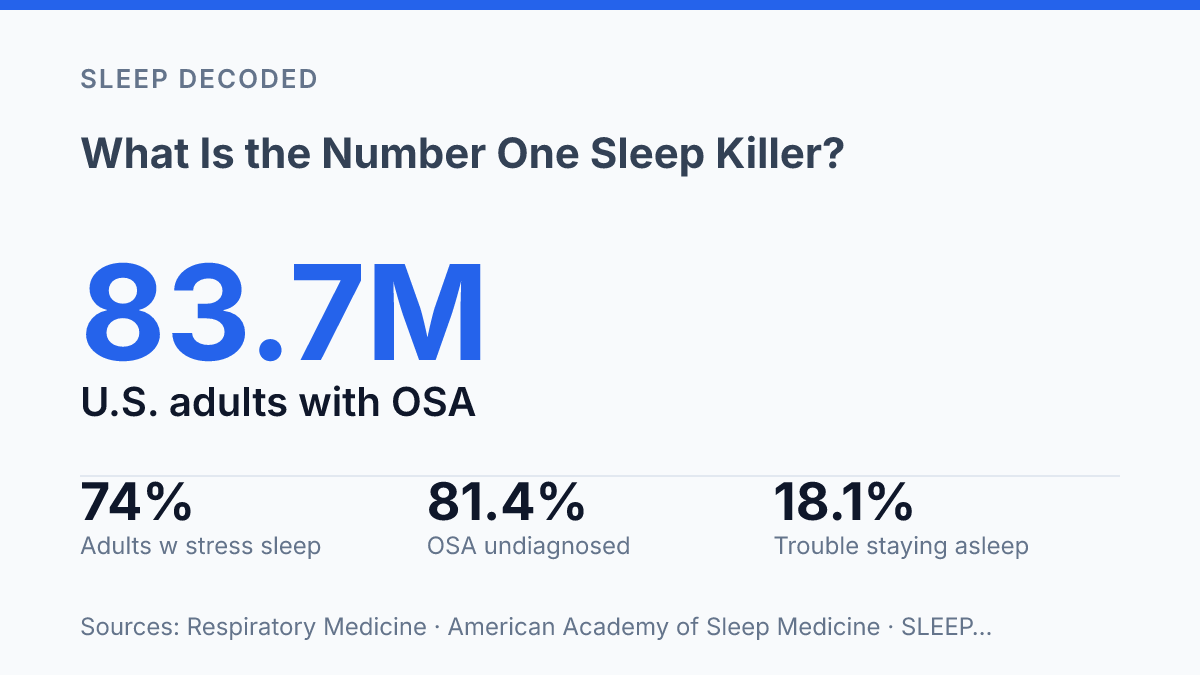
The answer to “What is the number one sleep killer?” is stress in recent survey data: 74% of U.S. adults told the American Academy of Sleep Medicine that stress disrupts sleep at least sometimes, ahead of anxiety at 68% and depression at 55%. The finding is clear enough to make stress the leading answer, but not clear enough to make it the only answer. Sleep can fail because cortisol and hyperarousal keep the brain alert, because noise or temperature repeatedly wakes the sleeper, or because obstructive sleep apnea interrupts breathing without being recognized.
Recent estimates place U.S. adult sleep apnea prevalence at 32.4%, and many moderate-to-severe cases remain undiagnosed. The question therefore is not just which factor ranks first, but which mechanism is actually keeping sleep from becoming stable.
Stress and cortisol: the leading cause of poor sleep
74% of U.S. adults said stress disrupts their sleep sometimes, often, or always, placing it ahead of anxiety at 68% and depression at 55% in a 2,006-person survey fielded May 16–24, 2024, according to the American Academy of Sleep Medicine. That ranking helps explain why stress is often described as the leading everyday sleep disruptor, especially when the complaint is difficulty falling asleep, waking during the night, or feeling unable to “switch off” despite fatigue.
The 2023 findings from the academy on stress and insomnia risk fit a well-established clinical pattern: sleep is most vulnerable when mental strain becomes physiological arousal. Work pressure, caregiving responsibilities, conflict, deadlines, and financial strain can all keep the brain monitoring for problems at the point when sleep requires reduced alertness. The content of the worry varies, but the sleep effect is similar: attention narrows around unresolved demands, and bedtime becomes associated with effort rather than recovery.
The physiological bridge is cortisol, one of the body’s main stress hormones. Cortisol normally follows a daily rhythm, rising toward morning and falling at night, but sustained stress can keep arousal systems more active than sleep allows. When that activation remains elevated in the evening, sleep onset is delayed because heart rate, body temperature regulation, attention, and threat monitoring remain closer to a waking state.
Night waking follows the same logic. A person may fall asleep initially, but hyperarousal can make brief normal awakenings more noticeable and harder to settle from, especially in the second half of the night when thought-based stress often returns quickly. Research supports this connection without making cortisol the whole explanation: a 2022 review of 20 case-control studies found moderately higher cortisol levels in people with chronic insomnia than in good sleepers, suggesting that stress biology is a contributor rather than a standalone cause.
Stress rarely acts in isolation. Evening routines, caffeine timing, bedroom conditions, pain, mood symptoms, and other health factors can strengthen or weaken its effect. The practical implication is that stress may be the most common trigger, but persistent poor sleep often reflects an interaction between arousal, habits, health, and environment rather than one single cause.
Other major sleep disruptors that can outrank stress
For millions of adults, the main sleep thief is not a racing mind but an airway that repeatedly closes after sleep begins. Respiratory Medicine estimated that 83.7 million U.S. adults age 20 or older had obstructive sleep apnea in 2024, a scale large enough to make apnea a leading alternative explanation for broken sleep. The disorder is marked by repeated breathing pauses or shallow breathing during sleep, often followed by brief arousals that restore airflow but fragment the night. Because these arousals may be too short to remember, the most noticeable clues can be loud snoring, witnessed pauses, morning headaches, and daytime fatigue rather than a clear sense of being awake for hours.
Underdiagnosis makes apnea especially easy to misclassify as ordinary insomnia or lifestyle-related tiredness. A 2026 SLEEP Advances study found that 81.4% of participants with moderate-to-severe obstructive sleep apnea identified by home polysomnography had never been diagnosed; even among severe cases, 76.4% were undiagnosed. That matters because untreated apnea can keep sleep shallow even when bedtime habits look reasonable, and sedating oneself does not correct the repeated breathing disruption.
Substances can also outrank emotional strain as the immediate cause of poor sleep, especially when timing and dose are unfavorable. Caffeine blocks adenosine signaling, so coffee, energy drinks, pre-workout products, and some teas taken later in the day can delay sleep or make it lighter.
Alcohol may shorten the time it takes to fall asleep, but it commonly fragments the second half of the night and can worsen snoring or breathing instability by relaxing upper-airway muscles. Nicotine is a stimulant, and overnight withdrawal can also contribute to early waking, which gives tobacco and vaping products two routes into sleep disruption.
Work schedules create a different problem: the sleep opportunity may be present, but the body clock is being asked to operate on the wrong timetable. Night shifts often require sleep during the biological day, when light exposure and circadian alerting signals can oppose deep rest. Rotating shifts add instability because the timing of sleep, meals, commuting, and light exposure keeps changing before the circadian system can fully adapt.
For that reason, a single “top” cause is partly a population question. In an insomnia clinic, persistent difficulty initiating or maintaining sleep may dominate; among shift workers, circadian misalignment may be the central driver; among people with untreated apnea, repeated airway obstruction can be the main reason sleep never feels restorative.
How to tell the difference between insomnia and a medical sleep disorder
The clue that sleep loss may be medical rather than behavioral is often found after waking, not only at bedtime. Loud habitual snoring, gasping or choking during sleep, morning headaches, dry mouth on waking, unexplained high daytime sleepiness, and dozing during passive activities can point toward a sleep-related breathing problem or another disorder that fragments sleep without always causing full awareness during the night. These signs matter because a person may describe the same complaint as insomnia, poor sleep quality, or fatigue, while the underlying mechanism can be quite different.
Persistent insomnia has a time-and-frequency pattern that helps separate an occasional bad stretch from a clinical disorder. The usual threshold for chronic insomnia is difficulty falling asleep, staying asleep, or waking too early at least three nights per week for at least 3 months, with daytime impairment such as reduced concentration, irritability, low energy, or poorer functioning. That pattern can exist on its own, but it can also coexist with pain, mood disorders, medication effects, breathing disturbances, restless legs symptoms, or circadian timing problems.
Symptoms overlap enough that poor sleep quality alone is a weak guide to cause. Someone with stress-related hyperarousal may lie awake for long periods with clear awareness of worry or alertness, while someone with a breathing-related sleep disorder may believe they slept for enough hours yet wake unrefreshed.
Bed partners may notice snoring, pauses in breathing, restlessness, or unusual movements that the sleeper cannot report. Medical history, medication use, alcohol or sedative exposure, weight change, nasal obstruction, menopausal symptoms, neurological symptoms, and work schedule can all change the interpretation of the same sleep complaint.
Screening by a primary care clinician or sleep specialist is the usual next step when warning signs are present, symptoms are persistent, or daytime impairment is substantial. The VA/DoD clinical practice guideline from January 2025 recommends validated screening tools for both insomnia and sleep-related breathing disorders, rather than relying on a general complaint of “bad sleep.”
Depending on the pattern, evaluation may include questionnaires, review of sleep timing and medications, examination of airway or cardiometabolic risk factors, or a sleep study performed at home or in a sleep laboratory. The purpose is not to label every poor night as a disorder, but to avoid missing conditions that require targeted clinical management.
What actually helps most when sleep keeps breaking down
More sleep tips are rarely the best answer once insomnia has become self-perpetuating. The January 2025 VA/DoD guideline recommends cognitive behavioral therapy for insomnia (CBT-I) for chronic insomnia and advises against sleep hygiene education as a stand-alone treatment.
CBT-I targets the conditioned arousal and unhelpful sleep behaviors that keep insomnia going, typically through stimulus control, sleep scheduling, cognitive strategies, and relaxation skills. That distinction matters because chronic insomnia is not usually corrected by a better pillow, a warmer bath, or another list of rules.
Basic sleep habits still provide the foundation for treatment, especially when the problem is inconsistent timing or evening stimulation. The most useful priorities are a fixed wake time, a consistent wind-down period, a caffeine cutoff early enough to avoid bedtime effects, and reduced late-night light exposure from bright rooms and screens. These steps help align the circadian system and reduce avoidable arousal, but their role is supportive rather than curative when insomnia has become persistent.
Treatment should match the cause that is most likely keeping sleep fragmented. Suspected sleep apnea requires medical evaluation and condition-specific therapy rather than repeated attempts to force longer sleep.
Depression and anxiety also merit direct treatment when low mood, worry, panic, or rumination are driving wakefulness, since insomnia often improves more reliably when the psychiatric condition and sleep pattern are treated together. A medication review is also appropriate when sleep worsens after starting, stopping, or changing drugs, including some antidepressants, stimulants, steroids, decongestants, and blood-pressure medicines.
The practical priority is not to find one universal sleep killer, but to identify the mechanism that is active in the individual case. Behavioral changes can reduce common sources of disruption, and CBT-I is the best-supported treatment when chronic insomnia is the main pattern. When breathing disorders, mood disorders, anxiety disorders, or medication effects are sustaining the problem, more sleep hygiene usually adds little until the underlying driver is addressed.
The question that changes the next step
Poor sleep becomes easier to interpret when the first question changes from “How can sleep be forced?” to “What is preventing sleep from staying intact?” That shift matters because the correct response differs sharply across causes: chronic insomnia is best matched with CBT-I, suspected OSA calls for screening and possible sleep testing, and environmental disruption may need changes to light, sound, heat, or timing.
The 2025 VA/DoD guideline reflects that logic by recommending validated tools for both insomnia and sleep apnea rather than relying on sleep hygiene alone. A sleep problem that persists despite lower stress is not a failure of relaxation; it is evidence that the diagnosis may still be incomplete.
Frequently Asked Questions
Q: What is the most common cause of poor sleep?
A: Stress and anxiety are among the most common causes of poor sleep because they keep the brain in a heightened state of alertness. That makes it harder to fall asleep and easier to wake during the night. For many people, sleep problems improve only when the underlying stressor is addressed.
Q: Can caffeine really ruin sleep?
A: Caffeine can significantly delay sleep onset and reduce sleep quality, especially when consumed later in the day. It stays in the body for hours, so even afternoon intake can affect nighttime rest. Sensitivity varies, which is why some people notice disruption after relatively small amounts.
Q: How do screen habits affect sleep quality?
A: Screen use can interfere with sleep by exposing the eyes to light and by keeping the brain mentally engaged. Both effects can delay the body’s natural shift toward sleepiness. The impact is often stronger when screen use happens close to bedtime.
Q: What medical conditions are linked to trouble sleeping?
A: Sleep problems are commonly associated with conditions such as insomnia, sleep apnea, depression, and chronic pain. These conditions can disrupt sleep in different ways, from frequent awakenings to breathing interruptions or persistent discomfort. When sleep loss is regular, an underlying medical cause should be considered.
Q: When should sleep problems be checked by a doctor?
A: Medical evaluation is appropriate when poor sleep lasts for several weeks, affects daytime functioning, or includes symptoms such as loud snoring, breathing pauses, or extreme fatigue. Persistent sleep disruption can signal an untreated condition rather than a short-term sleep habit issue. Early assessment can help identify the cause and guide treatment.