
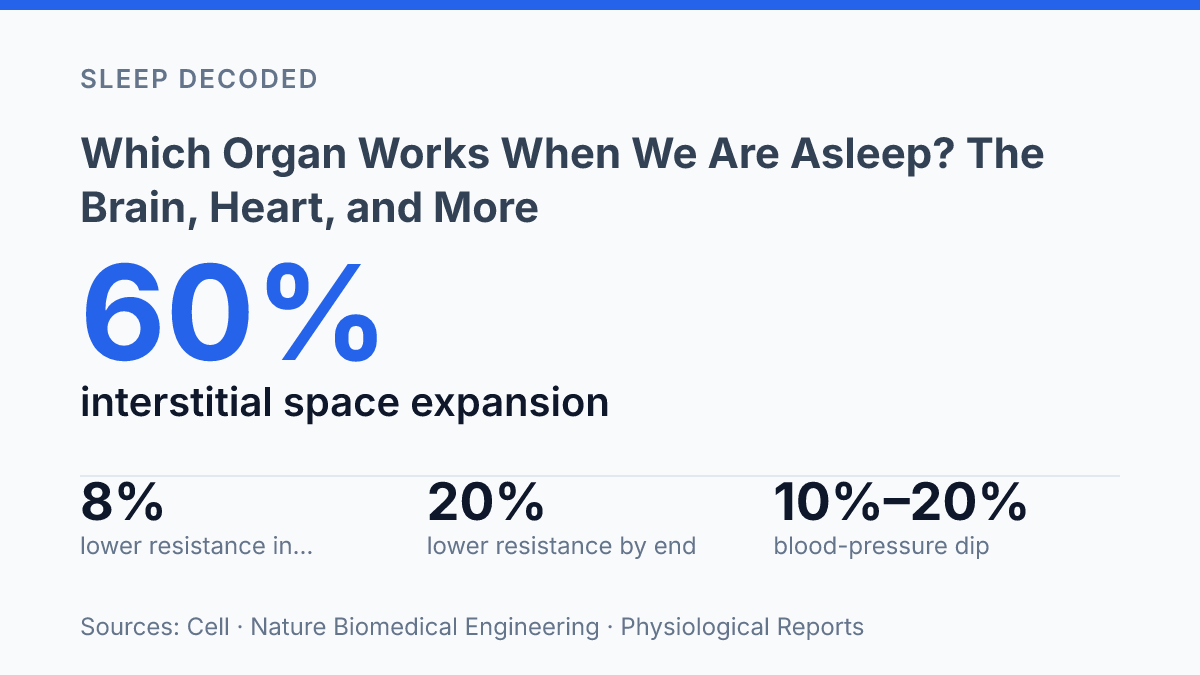
Which organ works when we are asleep? The brain is the clearest answer, cycling through four to six sleep-stage rounds each night, with each cycle lasting roughly 90 to 110 minutes. Sleep is therefore not a biological pause but a shift in operating mode: REM activity can resemble wakefulness on EEG, blood pressure usually falls by 10% to 20% without circulation stopping, and vasopressin helps the kidneys reduce urine production while filtration continues.
The more useful question is not whether one organ stays awake while the rest rests, but how several systems coordinate lower demand, repair, waste clearance, hormone timing, and fluid balance. That distinction explains why sleep can feel quiet from the outside while the brain, heart, liver, kidneys, and digestive system remain physiologically active in different ways.
The brain stays active through sleep stages
A sleeping brain can look electrically closer to wakefulness during REM than to deep non-REM sleep. That contrast is one reason sleep is better understood as a regulated shift in brain activity, not a nightly shutdown. The two main sleep states are non-REM sleep and REM sleep, and the brain moves between them in a repeated pattern rather than settling into one uniform mode.
According to StatPearls/NCBI Bookshelf in 2024, adults typically pass through sleep stages 4–6 times per night, each full cycle lasts about 90–110 minutes, and roughly 75% of sleep is non-REM. This distribution matters because non-REM sleep includes progressively deeper stages with slower, more synchronized electrical rhythms, while REM sleep is marked by faster, more wake-like brain activity. The brain is active in both states, but the pattern of activity is reorganized according to the stage.
Electroencephalography, or EEG, provides the clearest evidence for these differences. EEG recordings show distinct brain-wave patterns across sleep stages: lighter non-REM sleep differs from deeper slow-wave sleep, and REM sleep differs again.
These measurable electrical signatures are why sleep stages can be identified objectively in sleep laboratories rather than inferred only from outward stillness. A person may appear motionless, yet the cortex and deeper regulatory networks are cycling through structured patterns of activity.
Control of those cycles depends heavily on the brainstem and hypothalamus. The brainstem helps regulate arousal systems and the transitions between wakefulness and REM-related physiology, while the hypothalamus integrates circadian timing, sleep pressure, and wake-promoting signals. These regions do not act in isolation, but they serve as key control centers that help decide when the brain remains alert, enters non-REM sleep, or shifts into REM sleep.
The practical answer is that the brain continues working throughout the night, but not in the same way it works during waking life. Conscious awareness is reduced, sensory responsiveness changes, and voluntary movement is limited during parts of sleep. At the same time, neural circuits remain active enough to regulate sleep stages, maintain basic body functions, and support internal processes that depend on the architecture of sleep itself.
How the heart and blood vessels keep working overnight
A healthy sleeper’s blood pressure often falls by 10%–20%, according to Physiological Reports in 2025, which means the cardiovascular system is still actively regulating pressure rather than going idle. Heart rate usually slows as well, so the heart pumps against lower average pressure and with fewer beats per minute than during quiet wakefulness. This normal overnight fall is often called dipping, and it reduces cardiac workload without stopping circulation for even a moment.
The main controller is the autonomic nervous system, which shifts the balance of cardiovascular signals during sleep. Reduced sympathetic activity lowers the fight-or-flight drive that tends to speed the heart and tighten blood vessels, while parasympathetic influence becomes relatively stronger, especially in stable non-REM sleep. The effect is not uniform across the night: during more activated sleep periods, pulse and pressure can become more variable, so healthy sleep is better described as lower average cardiovascular demand than as a steady, equal slowdown.
Sleep disruption can reverse that pattern. Obstructive sleep apnea, for example, repeatedly narrows or blocks the upper airway, causing brief oxygen drops, arousals, and swings in chest pressure. Each event can trigger sympathetic surges that raise heart rate and blood pressure, and repeated nightly exposure is associated with higher risk of hypertension, atrial fibrillation, coronary artery disease, heart failure, and stroke, according to the American Heart Association.
Experimental disruption shows the same principle in a different setting. In one night-shift condition reported by Physiological Reports, sleep fell to 4 hours 04 minutes from 8 hours 22 minutes on a day-shift schedule, and systolic blood-pressure dipping fell to 8% from 12%. The heart keeps working in all cases, but uninterrupted sleep usually lets it work under calmer autonomic conditions.
Liver, kidneys, and digestion do their maintenance work
By breakfast, the liver has often spent several hours defending blood glucose without any new carbohydrate arriving from the gut. During the overnight fast, it releases stored glucose from glycogen and can make new glucose from non-carbohydrate sources, a process that helps keep the brain and other glucose-dependent tissues supplied. At the same time, liver metabolism continues to process fats, amino acids, hormones, and many chemical byproducts, so its overnight role shifts toward regulation and internal maintenance rather than handling a fresh post-meal nutrient load.
The kidneys also keep filtering blood during sleep, but nighttime urine output is normally restrained by water-conserving signals. Vasopressin normally rises during sleep, according to StatPearls, which helps the kidneys reabsorb more water and produce a smaller, more concentrated volume of urine. This is why nocturnal polyuria is defined as nighttime urine production above expected proportions, such as more than 20% of daily urine volume in younger adults or more than 33% in older adults, rather than as the mere presence of urine production at night.
Digestion slows at night without stopping completely. Circadian rhythms influence salivation, gut movement, gastric activity, and digestive secretions, aligning the gastrointestinal tract with the usual fasting and feeding cycle. A 2023 review in Current Treatment Options in Gastroenterology reported that salivary production falls by about 50% at night, a measurable sign of reduced digestive activity rather than shutdown.
The gut also has its own timing signals, not just passive responses to sleep. The same gastroenterology review notes that the gastrointestinal tract contains up to 400 times as much melatonin as the pineal gland, supporting the idea that digestive tissues participate in circadian regulation. Taken together, the liver, kidneys, and digestive tract remain active overnight, but much of their work turns toward glucose stability, fluid conservation, filtration, and timed metabolic housekeeping.
Why sleep helps the body recover instead of simply resting it
A short sleep opportunity can leave some recovery signals almost absent: in a 2024 SLEEP case study, planned sleep restricted to six 20-minute periods per day was followed by a 95% drop in daily growth-hormone release, from 1300 to 67 ng/mL after five weeks. That finding does not mean every form of short sleep produces the same result, but it shows why sleep structure matters. Growth hormone is released in pulses, with a large share commonly linked to deep non-REM sleep, and it helps regulate protein synthesis, tissue maintenance, bone metabolism, and other repair-related processes.
Recovery during sleep also involves immune regulation rather than simple inactivity. During normal sleep, immune signaling changes, inflammatory mediators fluctuate, and immune cells continue surveillance and coordination.
This activity is one reason poor or fragmented sleep is associated in research with altered inflammatory responses and weaker responses to some vaccines, although sleep should not be presented as a stand-alone treatment for infection or injury. The more accurate interpretation is that adequate sleep gives immune and repair processes a better-regulated physiological setting.
The sleeping brain has its own recovery pathway through the glymphatic system, a fluid-clearance process that helps move waste products away from brain tissue. Recent research has refined this model rather than treating it as a simple nighttime wash cycle.
A 2025 Nature Biomedical Engineering study reported that resistance within brain tissue was lower during sleep than wakefulness in older adults, while a 2025 Cell study in mice linked slow norepinephrine oscillations during non-REM sleep with blood-vessel and cerebrospinal-fluid movement. Animal findings do not transfer perfectly to humans, but they support the broader point that sleep changes the physical conditions under which brain waste clearance occurs.
Sleep therefore helps the body recover because it coordinates active processes across systems: hormone pulses, immune signaling, cellular repair, fluid movement, and metabolic regulation. The scale of those effects varies with sleep stage, age, health status, circadian timing, and sleep continuity. Resting quietly while awake may reduce effort, but sleep supplies organized biological conditions that waking rest does not fully reproduce.
Why Sleep Structure Changes the Answer
Sleep quality matters because the body is not just accumulating hours; it is passing through timed physiological states. A 2024 SLEEP case study showed how sensitive recovery signals can be to structure: when planned sleep was limited to 2 hours per day in six 20-minute episodes, daily growth-hormone release fell 95%, from 1300 to 67 ng/mL after 5 weeks.
That finding does not mean every short night causes the same effect, but it clarifies why fragmented or mistimed sleep can change what organs are able to do. The practical consequence is precise: sleep should be treated less like inactivity and more like scheduled maintenance with stages, timing, and continuity built into the process.
Frequently Asked Questions
Q: Which organ keeps working while a person is asleep?
A: Several organs remain active during sleep, including the brain, heart, lungs, kidneys, and liver. Sleep changes how they function, but it does not stop them from operating. The brain is especially active because it coordinates sleep stages, breathing control, memory processing, and hormone regulation.
Q: Does the brain really stay active during sleep?
A: Yes. The brain does not shut down during sleep; its activity shifts across sleep stages and continues to regulate vital functions. In some phases, such as REM sleep, brain activity can resemble wakefulness in certain patterns, which helps explain dreaming and memory processing.
Q: Do the heart and lungs work normally during sleep?
A: The heart and lungs continue working throughout sleep, although their rates often change. Breathing usually becomes slower and more regular in non-REM sleep, while heart rate tends to drop. These changes reflect a lower metabolic demand, not a pause in function.
Q: Why do people need sleep if so many organs are still active?
A: Sleep supports processes that daytime wakefulness does not replace well, including tissue repair, memory consolidation, and immune regulation. Ongoing organ activity during sleep is part of maintaining essential functions, but the body still needs sleep to restore and regulate systems efficiently. Without adequate sleep, multiple organs and control systems begin to function less effectively.
Q: Can sleep quality affect organ health?
A: Yes. Poor or insufficient sleep is associated with higher stress on cardiovascular, metabolic, and immune systems. Over time, disrupted sleep can contribute to worse blood pressure control, impaired glucose regulation, and reduced recovery, which affects how well organs function.