
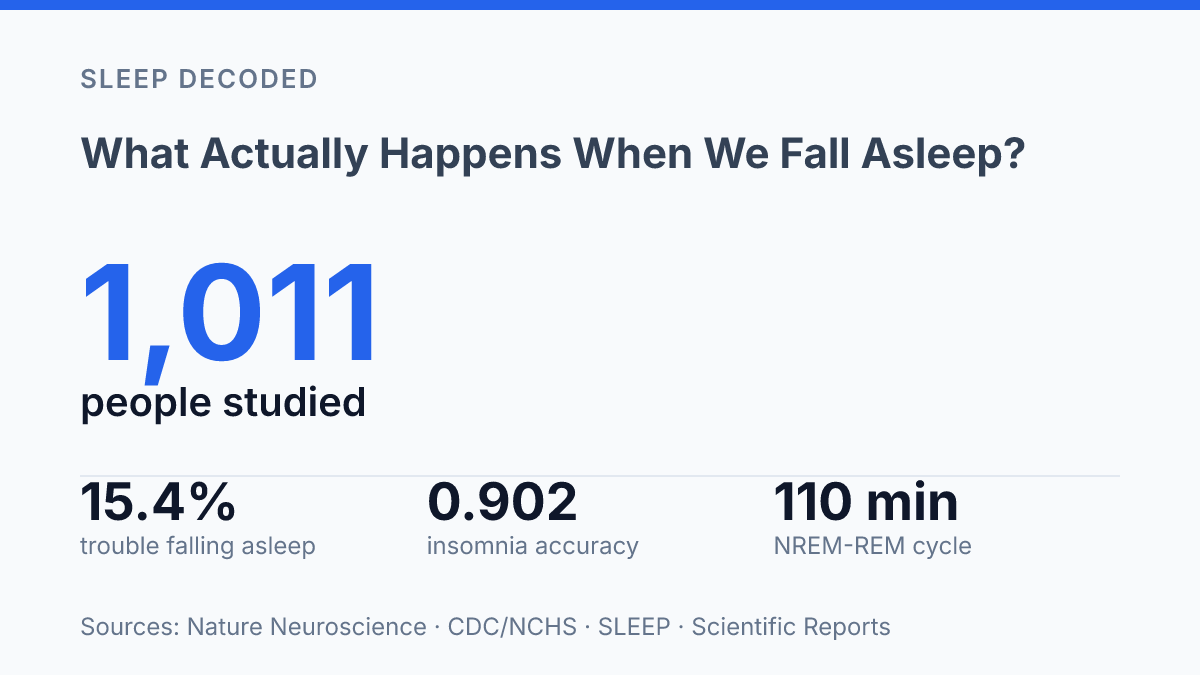
The answer to “What actually happens when we fall asleep?” is becoming measurable: in a 2025 Nature Neuroscience study of 1,011 people, a wake-to-sleep tipping point appeared 4.5 minutes before conventional scoring labeled participants asleep. At that point, standard scoring still classified the recordings as 94.12% wakefulness, which shows why the border between waking and sleeping can feel indistinct. Sleep onset is not a single command sent across the nervous system.
EEG patterns shift from alpha toward theta and slower activity, some brain regions change earlier than others, heart rate falls quickly, and core temperature drifts down over a longer interval. These overlapping changes help explain why drifting off may feel smooth one night and unsettled the next. The article examines the transition from alertness into early sleep, the roles of the first stages, the body’s parallel adjustments, and the reasons this threshold varies across people and nights.
How the brain switches from alertness to sleep
In a 2025 Nature Neuroscience study of 1,011 people, a measurable wake-to-sleep tipping point appeared 4.5 minutes before conventional scoring labeled participants asleep, even though the same recordings were still classified as 94.12% wakefulness at that point. That finding helps explain why sleep onset is better understood as a transition than as an instant shutdown. The brain begins changing its arousal state before a person would necessarily be scored as asleep in the laboratory, and different systems do not shift at the same speed.
The timing signal for this transition is coordinated largely by the suprachiasmatic nucleus, a small paired structure in the hypothalamus that receives light information from the eyes. Bright light, especially in the evening, signals biological daytime and helps sustain alertness; darkness permits the circadian system to favor sleep-supporting physiology, including melatonin release from the pineal gland.
This circadian signal does not force sleep by itself, but it changes the probability that sleep will occur at a given time. As a result, a person can feel sleepy at the usual bedtime even if the day has not produced unusually high sleep pressure.
Sleep pressure is shaped by adenosine, a chemical byproduct of cellular energy use that accumulates during wakefulness. As adenosine binds to its receptors in the brain, wakefulness becomes harder to sustain and the tendency to sleep rises.
Caffeine interferes with this process because it occupies adenosine receptors without activating them, which can make the brain register less sleep pressure than is actually present. The effect is timing-dependent: caffeine taken late in the day can oppose the homeostatic drive toward sleep even when circadian timing is beginning to favor it.
At the same time, activity in wake-promoting networks begins to recede. The reticular activating system, which helps maintain cortical alertness through brainstem and forebrain pathways, becomes less dominant as arousal signals weaken and sleep-promoting circuits gain influence.
This is not a clean handoff from “on” to “off”; it is a change in balance among competing neural systems. The result is the familiar unstable borderland before sleep, when awareness can fade, return briefly, and then fade again as circadian timing, adenosine pressure, and reduced arousal converge.
The first sleep stages and what they do
The lightest sleep stage is often so thin that brief sounds or a shift in posture can pull a person back into wakefulness. In stage N1, EEG patterns move away from the relaxed waking rhythm and show more 4–7 Hz theta activity, according to StatPearls/NCBI Bookshelf’s 2026 EEG sleep staging table. This stage is short, typically accounting for only about 5% of total sleep, and it corresponds to the familiar sense of drifting, losing track of surroundings, or briefly jerking awake.
What the body changes while sleep begins
Heart rate can start falling soon after lights-out, but core body temperature changes more slowly, with one pooled analysis tracking the early decline over about 1.5 hours. In a 2024 Scientific Reports study of 72 healthy adults, heart rate decreased quickly after lights-out while core temperature followed a slower downward path. That pattern reflects a coordinated shift rather than a single event: the body begins conserving energy, losing heat, and reducing cardiovascular drive as sleep onset approaches.
Body temperature falls because the body increases heat loss, especially through the skin of the hands, feet, and limbs, while the internal core gradually cools. This cooling is not merely a passive effect of lying still; it is part of the timing system that helps make sleep more likely at night. A warm bedroom, late exercise, fever, or alcohol-related temperature changes can interfere with this pattern by making it harder for the body to settle into its normal night-time thermal rhythm.
Melatonin provides a hormonal signal that reinforces this timing. As evening progresses, secretion from the pineal gland rises and helps mark biological night, making sleep onset more likely when other conditions also support it. Bright light exposure in the evening can delay or suppress this rise, which is why light timing can shift the body’s readiness for sleep even when fatigue is present.
Breathing also changes as sleep begins, typically becoming slower, quieter, and more regular. Blood pressure tends to decline as sympathetic arousal eases and parasympathetic influence becomes more prominent, reducing the cardiovascular activation associated with wakefulness. These changes can be blunted by stress, irregular schedules, stimulant use, or alcohol, all of which can keep autonomic activity higher than expected at bedtime.
Muscle tone decreases during the transition into sleep, first as a general relaxation of the face, jaw, neck, and limbs rather than the near-paralysis associated with later REM sleep. Responsiveness to ordinary sounds, light touch, and other external stimuli also drops, although strong or personally meaningful signals can still produce awakening. This explains why sleep onset can look quiet from the outside while the body is actively changing its temperature regulation, hormone signaling, breathing, circulation, and sensory thresholds.
Why sleep onset can feel different from night to night
A one-hour delay in falling asleep can be a normal response to crossing time zones, but the same delay night after night can become clinically meaningful when it impairs daytime function. Sleep onset varies because the transition depends on timing, arousal, recent exposures, and the person’s sleep history. Jet lag can place bedtime at the wrong biological phase, shift work can require sleep during a period when the body is still promoting wakefulness, anxiety can keep attention and threat monitoring active, and late caffeine intake can make sleep feel less accessible even when a person is tired.
Researchers treat this variability as measurable rather than merely subjective. In 2025, a Nature Neuroscience study of 1,011 people found a wake-to-sleep tipping point 4.5 minutes before conventional scored sleep onset, when standard scoring still classified participants as 94.12% wakefulness, 5.55% N1, and 0.003% N2. That finding helps explain why someone may report feeling half-awake or uncertain about whether sleep has started, especially on nights when arousal or schedule disruption makes the transition less stable.
In clinical sleep testing, sleep latency is the interval between lights-out and the first scored sleep epoch, usually assessed with polysomnography in 30-second segments. The number matters because it translates a vague complaint, such as taking too long to fall asleep, into a comparable measure. A related daytime test, the Multiple Sleep Latency Test, measures how quickly a person falls asleep across scheduled nap opportunities, which can help evaluate excessive sleepiness rather than difficulty initiating sleep at night.
Longer sleep latency is not, by itself, a diagnosis. A delayed start to sleep after travel, schedule changes, emotional stress, or stimulant exposure can fall within ordinary variation.
Concern rises when difficulty falling asleep is persistent, occurs despite adequate opportunity for sleep, and is paired with daytime consequences such as fatigue, reduced attention, irritability, or impaired work or school performance. In that context, prolonged sleep latency may support evaluation for insomnia or another sleep-wake disorder rather than being dismissed as a normal bad night.
Why the minutes before sleep deserve closer attention
Seeing sleep onset as a graded process changes what counts as useful evidence. A person may feel awake while parts of the brain and autonomic system are already moving toward sleep, which means subjective experience and laboratory scoring can disagree without either being wrong. The next practical step is better measurement: combining EEG with heart-rate variability and temperature trends may help distinguish normal variation from persistent insomnia risk.
It also argues for caution when interpreting a single restless night. The first minutes after lights-out are not a pass-fail test; they are a shifting physiological interval, and small differences in timing may carry more information than the moment sleep is officially scored.
Frequently Asked Questions
Q: What changes in the brain when a person falls asleep?
A: Sleep is marked by a shift from wakeful, externally focused activity to coordinated sleep states that cycle through the night. Brain waves, neurotransmitter activity, and responsiveness to the environment all change, which is why awareness and reaction speed drop sharply.
Q: Why does the body become less responsive during sleep?
A: The nervous system reduces its responsiveness to outside stimuli during sleep, especially in deeper stages. This lower reactivity helps protect sleep continuity and supports processes involved in restoration and memory.
Q: What are the main stages of sleep?
A: Sleep is generally divided into non-REM and REM sleep, with non-REM including lighter and deeper stages. These stages repeat in cycles across the night, and each one supports different functions such as physical recovery and memory processing.
Q: Why do dreams happen during sleep?
A: Dreaming is most commonly associated with REM sleep, when brain activity becomes more similar to wakefulness. Researchers do not agree on a single explanation, but dreams are thought to reflect memory consolidation, emotional processing, and ongoing brain activity during sleep.
Q: How much sleep does an adult typically need?
A: Most healthy adults need about 7 to 9 hours of sleep per night, though individual needs can vary. Consistently sleeping too little can impair attention, mood, immune function, and long-term health.